
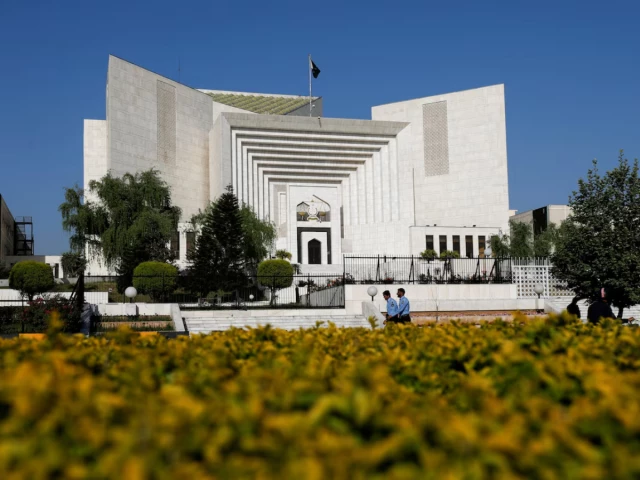
Police officers walk past Pakistan’s Supreme Court building, in Islamabad, Pakistan, April 6, 2022. REUTERS
ISLAMABAD:
A petition filed in the Supreme Court on Thursday challenging the transfer of three judges of the Islamabad High Court (IHC) has brought the controversy to the fore, arguing that the move violates constitutional guarantees and undermines judicial independence.
The petition, filed by Lahore Bar Association president Irfan Hayat Bajwa through senior lawyer Hamid Khan, maintains that the transfers were carried out “without any publicly disclosed reason, criteria or demonstrable institutional need.”
He alleges “lack of transparency and absence of procedural guarantees.”
It also maintains that judicial independence is part of the “basic characteristics” of the Constitution and warns that any erosion of it “undermines the Constitution.”
The legal challenge comes as Justices Babar Sattar and Mohsin Akhtar Kayani prepare to take up judicial duties at the Peshawar High Court (PHC) and Lahore High Court (LHC), respectively, following their transfers from the IHC.
The transfers, approved by the Judicial Commission of Pakistan (JCP) on April 28 and notified by the Ministry of Justice on April 29, also included Justice Saman Rafat Imtiaz, who has been transferred to the Sindh High Court. The decision has drawn criticism from sections of the legal fraternity.
Court rosters released Thursday confirmed that the transferred judges will begin hearing cases in their new positions next week.
The revised LHC list for May 4 to July 4 shows that Justice Kayani will serve as a single bench judge in the main seat, where 27 single benches and nine divisional benches have been constituted, as notified by Additional Registrar (Judicial) Shabbir Hussain Shah.
In the PHC, Justice Sattar has been listed for May 4-7 and will sit on a division bench in the main seat on Monday alongside Justice Wiqar Ahmad.
The PHC list, approved by Chief Justice SM Attique Shah, lists nine individual seats and one divisional bench.
In its arguments, the petition questions the legality of the transfers provided for in Article 200 of the Constitution, stating that the exercise of such powers without defined criteria “makes the process arbitrary, opaque and susceptible to being annulled.”
He also raises constitutional concerns related to the 27th Constitutional Amendment, stating that changes affecting judicial jurisdiction were illegal and describing the amendment as “a fraud on the electorate”, while stating that Parliament lacked the mandate to enact such measures.
The reason also questions the transfer of jurisdiction from the TS to a newly created Federal Constitutional Court, questioning whether said court can resolve matters related to its own creation.
It reiterates that “in the absence of revealed reasons, criteria or demonstrable institutional need, transfers of judges… are illegal” and warns that large-scale transfers without replacement have caused “institutional disorganization” and risk eroding public confidence in the judiciary.
The petitioner has asked the SC to declare the transfers unconstitutional and void, and to issue instructions clarifying the constitutional framework governing judicial appointments and transfers.


