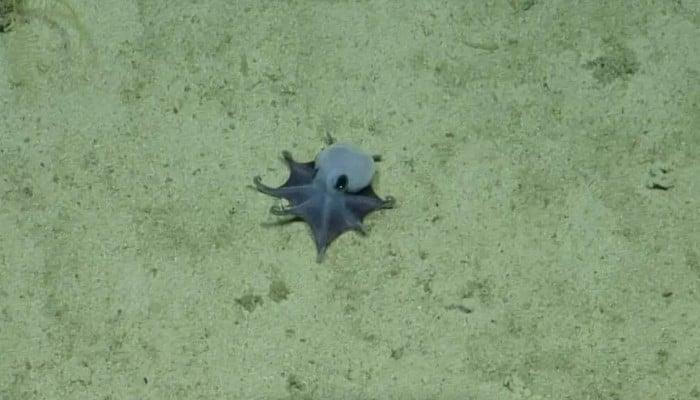
PARIS: At the bottom of the ocean near the Galapagos Islands, a submersible controlled by scientists encountered a mysterious octopus as blue as the ocean and no bigger than a golf ball.
“It’s small! It’s blue!” What an excited scientist said when she first saw the cerulean cephalopod was recorded in images transmitted from the submarine.
The Charles Darwin Foundation team had just discovered a new species of octopus nearly 1,800 meters (5,900 feet) below the water’s surface, according to research published Monday.
“I immediately knew it was something really special,” said octopus expert Janet Voight, who was asked to identify the rare species.
At first, the curator of the Field Museum of Natural History in Chicago had to make do with photographs of the animal.
He then received the preserved body in the mail.
“When it arrived, I thought, ‘Oh! My God! It’s beautiful,'” Voight said. AFP.
He immediately became interested because the closest known octopus with that shape lives off the coast of Uruguay, in a different ocean on the other side of South America.
Normally, to describe a new species of octopus, it is necessary to open a specimen so that its mouth, beak, teeth and other parts can be examined.
“We only had one specimen, so I didn’t want to take it apart,” Voight said.
Instead, the Field Museum team used CT scans to take thousands of X-ray images and then compiled them to make a 3D model of the octopus, revealing its interior.
“There’s nothing like spending the day looking at something no other human being has ever seen,” the head of the Field Museum’s X-ray laboratory, Stephanie Smith, said in a statement.
‘Intense purple’
The new species, called Microeledone galapagensis, stands out for reasons other than its blue hue, which is believed to be the rarest color in nature.
The octopus appears to be the runt of the family Megaleledonidae, whose members are typically much larger and live in the Southern Ocean surrounding Antarctica.
“Its stubby little arms with a single row of suction cups set it apart from most octopuses we know,” Voight said.
Even among “other species with short arms and a single row of suckers, their coloration and the soft skin on their backs separate them,” he added.
While the octopus is light blue on its back, underneath it is a “very deep purple,” Voight said.
“We think this color pattern helps keep it safe. If the octopus grabs prey that emits light, that light can attract predators that could then eat the octopus,” he explained.
“Thus the octopus covers its prey with its dark-colored net, keeping itself safe.”
Surprisingly, it is not uncommon to find new species of octopus in the deep sea, particularly in areas that have not been well explored, which is a huge amount of the ocean floor.
“If you took all the land on Earth and put it together, you wouldn’t cover the Pacific Ocean,” Voight noted.
He added that he had last seen a new octopus in 2023, off the coast of Costa Rica.
The first sighting of the new blue octopus was made in 2015 near Darwin Island, named after the English scientist whose visit to the Galapagos helped him formulate the theory of evolution.
Voight’s research on the species was published in the journal Zootaxa.