
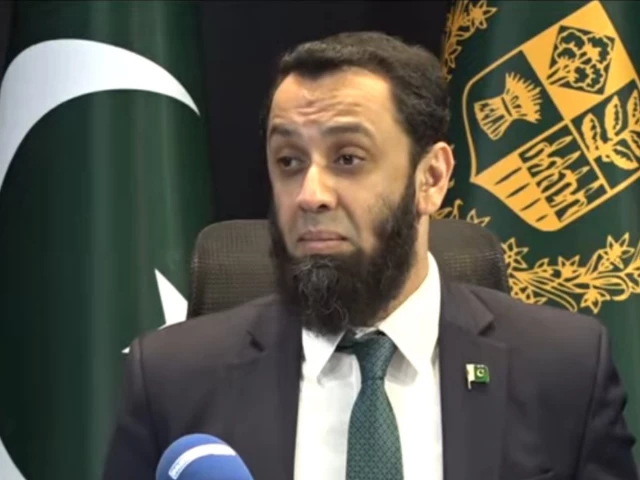
Federal Information Minister Attaullah Tarar on Sunday said investigators had uncovered an India-linked digital propaganda network aimed at spreading misinformation and anti-state content in Pakistan, a social media campaign linked to the Joint Action Committee (JAC) in Azad Jammu and Kashmir (AJK) was funded from across the border.
Addressing a press conference in Islamabad, Tarar said security agencies had recently arrested a person providing digital marketing services whose activities had links to India.
It revealed that investigators discovered that payments to promote and amplify social media content in Pakistan were made through payment gateways originating from India.
“During the investigation, it emerged that an entire disinformation network was operating through bot farms,” Tarar said, adding that the network was used to spread “anti-state content” targeting Pakistan, its institutions, the government, the armed forces and the army chief.
According to the minister, researchers attributed much of the promoted content to campaigns around the JAC in AJK.
“We had been saying from day one that this JAC wanted to weaken the relationship between Kashmir and Pakistan,” Tarar said, the move was part of a larger conspiracy than a campaign for the rights of Kashmiris.
Read: AJK suspends 20 education employees over JAAC protest
He also questioned why the group had not participated in the democratic process if it truly represented public interests.
Referring to earlier protests in Azad Kashmir, Tarar accused the committee of encouraging violence, creating law and order problems and taking law into its own hands by blocking roads and staging armed protests.
The minister claimed that authorities now possessed “irrefutable evidence” linking the campaign to India.
“There should no longer be any doubt that their links lead to India, and we now have undeniable evidence,” he said.
Tarar said social media campaigns supporting JAC were funded from India, revealing that technical investigations had traced the payments.
“All payments for JAC social media content came from India, and this has been established through technical data,” he said.
He further claimed that investigators had recovered WhatsApp conversations between the arrested suspect and an Indian operator regarding payments, target audience and account details.
According to Tarar, the payments were transferred in small amounts to avoid detection by financial monitoring systems.
It also revealed that forensic investigators had traced the origin of several online accounts to India despite the use of virtual private networks (VPNs).
“When a VPN masks a user’s location, the device itself can still be identified during forensic analysis. That’s how these India-based accounts were detected,” he said.
Tarar said the government was also examining the digital payment gateways used in the operation and vowed that authorities would continue to expose what he called coordinated disinformation campaigns.
Read more: JAAC uses ‘social networks to incite people’
He further claimed that the network promoted sectarianism, anti-state narratives and anti-military content through coordinated bot activity.
The minister maintained that such campaigns sought to damage public confidence in state institutions, but insisted they would not be successful.
“No one can weaken Pakistan. These types of propaganda and disinformation campaigns will continue to be exposed by the government, the armed forces and our security institutions,” Tarar said.
Tarar showed examples of social media posts linked to the investigation, saying they were aimed at inciting violence, spreading misinformation and undermining state institutions.
“These publications are related to the JAC. They encourage people to rebel and contain propaganda against the army, the country and state institutions,” Tarar said.
He said the material promoted “violence, hatred and false propaganda” and was circulated across various social media platforms to influence public opinion.
Tarar said the investigation into the arrested suspect was continuing and additional digital evidence had already been recovered.
“AI-generated images were used, while old videos and images from other countries and places were falsely presented as incidents occurring in Kashmir,” Tarar said.
The minister said the campaign also sought to fuel sectarian tensions and create divisions within society.
Also read: Rangers personnel martyred in Rawalakot attack by banned JAAC armed groups
Tarar said combating disinformation was the government’s responsibility and “we will continue to do so with technical expertise, just as we have exposed this conspiracy,” he said.
He added that Pakistan’s international standing had improved and said the government would continue to work to safeguard the country’s reputation.


