
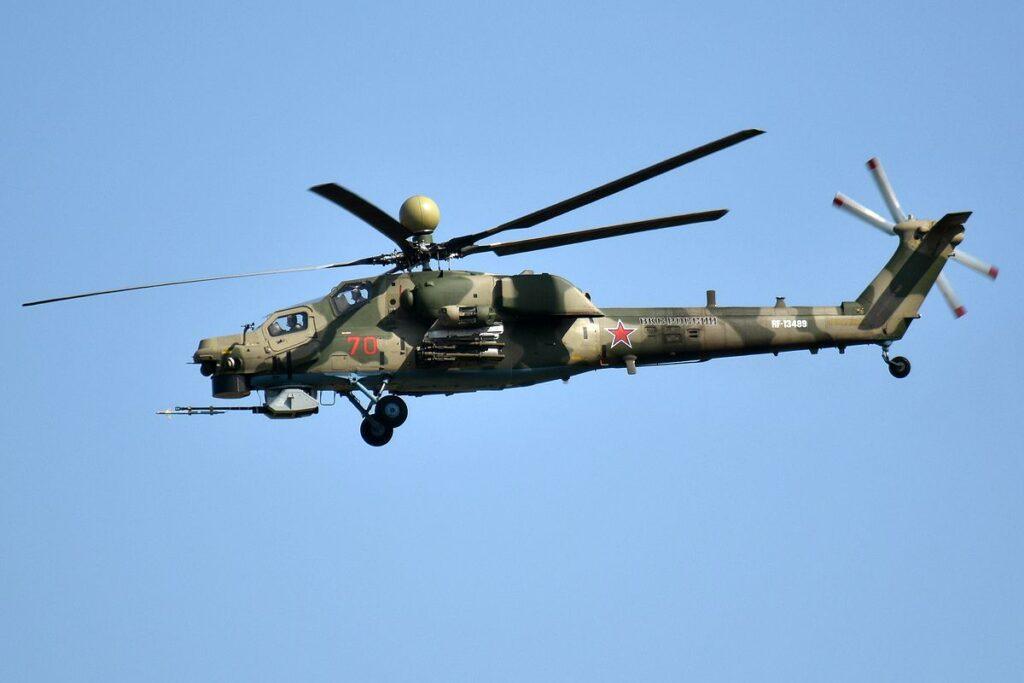
- Ukraine’s Unmanned Systems Forces (USF) attacked a Russian Mi-28 attack helicopter in flight over the Belgorod region with a SkyFall Shrike 10 FPV drone, hitting the helicopter from above.
- The attack, which saw a $400 drone strike “kill” a $19 million attack helicopter according to Skyfall, represents an impressive 47,500x exchange ratio.
- The attack is not isolated: Russia has lost more than 20 Mi-28s in similar attacks since the conflict began in 2022.
The Russia-Ukraine conflict continues to expand as the latter continues to take advantage of asymmetric warfare to defend itself against a rival with superior technology and manpower, even as the conflict approaches its fifth year.
Much of this is due to Ukraine’s shift towards local drone and robot manufacturing, which helps counter Russian heavy weaponry such as tanks, helicopters and APCs, using cheap but effective drones and robots to hold the line.
It has also allowed several startups to join the fray, offering low-cost options, often funded by external partners and allies, to bolster Ukraine’s war effort, and SkyFall’s Shrike 10 FPV drone is one of them.

An impressive achievement, albeit with controversial claims
The Shrike 10 FPV drone, which costs less than a mid-range smartphone, flew alongside a Russian Mi-28 attack helicopter, climbed above it and dove onto its tail on the morning of July 17, 2026, in Russia’s Belgorod region.
The attack was carried out by operators of the 427 Separate Unmanned Systems Brigade “Rarog”, and confirmed by Major Robert “Magyar” Brovdi, commander of the Ukrainian Unmanned Systems Forces (USF), who published the images of the drone’s final approach on Telegram with the concise caption that the “Night Hunter” had “sank into the ground.”
Ukrainian company SkyFall, whose FPY drone, the Shrike 10, was involved in the attack, said it was priced at less than $400 per unit. The Mi-28, according to the same company, costs 19 million dollars.
While the headline is impressive, the calculations may not quite add up: other sources put the cost of the Mi-28 at around $15 million, while a recent deal with Germany – 50,000 FPV drones built by SkyFall for Ukraine, equipped with autonomous guidance software from US firm Auterion in a €90 million (~$103 million) deal – could mean some liberties may have been taken in arriving at the figure. of $400, although the Shrike 10 that attacked the Mi-28 could have a different configuration or be on the lower end of the spectrum.
The case, in which Ukraine claims to have killed what is an expensive part of the Russian arsenal, is partially unconfirmed, with independent observers noting that there is no subsequent video and that attack helicopters often survive and land successfully after such attacks. However, to its credit, the Ukrainian military reported a similar death in 2025 with images confirming the crash that followed.
Regardless of the sum, the fact that a drone costing one-ten-thousandth the price of an attack helicopter that has been adapted to hunt it could be a credible predator of it is potentially alarming, not only to the Russians but to military planners around the world, even if the damage in question might be open to controversy.
This is further corroborated by unverified sources who claim that the damage was “minor” and did not affect either of the two occupants of the helicopter at the time, thus calling into question many of SkyFall’s claims beyond the impact of the drone.
However, Russia’s Defense Ministry has not commented directly on the matter, and no open source tracker like Oryx has confirmed images of the plane’s wreckage.
Ukrainian President Volodymyr Zelensky recently said the nation is producing 10 million drones a year as it competes for a production target of 20 million drones in the future, much of it backed by foreign aid, indicating that the Russian Mi-28, which has more than 20 confirmed visual losses since the conflict began, remains both an attacker and a defender against drones of all shapes and sizes.

Follow TechRadar on Google News and add us as a preferred source to receive news, reviews and opinions from our experts in your feeds.


