
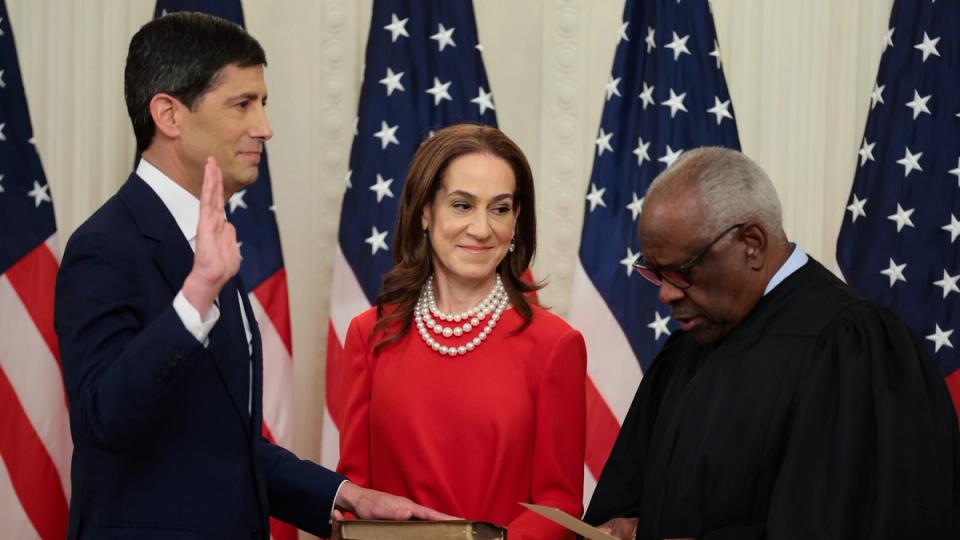
bitcoin faces selling pressure ahead of today’s Federal Open Market Committee (FOMC) interest rate decision in the first meeting under new Federal Reserve Chairman Kevin Warsh.
The largest cryptocurrency retreated below $65,000 after trading near $67,000 just a day earlier, CoinDesk data shows. The broader market CoinDesk 20 index (CD200) has lost 1.2% since midnight UTC, and all but four tokens have declined.
“The main focus of the week is the FOMC meeting under new leadership, with market expectations for interest rate increases already priced in through 2027,” Laser Digital said in its weekly note.
The market is not pricing in any change in the federal funds rate at this meeting. Instead, the focus will be on Warsh’s post-meeting press conference for signals about his views on inflation. Warsh has criticized the Federal Reserve’s frequent press conferences and detailed forecasts and may face questions about his stance.
Among the notable gainers, Uniswap’s UNI token rose another 20% in 24 hours, boosted by Standard Chartered’s bullish forecast of $100 by 2030. Meanwhile, NEAR, INJ and several stablecoin-related assets fell as much as 8%.
Derivatives positioning
- The market remains calm ahead of the Federal Reserve’s decision. Activity has slowed, with cryptocurrency futures volume falling 20% in 24 hours to $165 billion and open interest falling 2.3% to $110 billion. Settlements fell to approximately $310 million, down 44%.
- Calm is also evident in BVIV, bitcoin’s 30-day implied volatility index, which was hovering around 39% annualized at the time of writing, a level not seen since June 2, just before skyrocketing to nearly 59% a few days later. Ether’s volatility index shows similar stability.
- Cardano’s ADA stands out among altcoins. Open interest has risen to 2.26 billion tokens, approaching the record of 2.32 billion set on June 6 and recovering from the June 13 low of 2 billion.
- The bounce points to a renewed deployment of capital into leveraged ADA markets, although the move is not necessarily bullish. The token price has fallen from over 18 cents to under 17 cents in two days along with a negative 24-hour cumulative volume delta. The mix is tilted to the downside, pointing to aggressive trading with market orders rather than passive limit orders.
- ZEC and SUI are the other notable open interest gainers in the last 24 hours, while NEAR and BCH led the losers.
- NEAR is down more than 9%, and the decline in open interest suggests traders are unwinding leverage during liquidation rather than accumulating new short positions.
- Most major tokens, with the exception of TRX and CC, show a negative 24-hour CVD, pointing to a broad bearish dominance in trading flows.
- In the options markets, BTC puts continue to dominate the 24-hour volume rankings, although the $80,000 call expiring on March 26 next year also saw notable activity. In the case of ether, calls lead the volume ranking.
symbolic talk
- UNI is up for the seventh consecutive day, its longest winning streak since August 2023, when it achieved eight. The token is trading near $2.75, erasing its June losses after jumping more than 10% earlier in the week.
- The accelerator was a Standard Chartered note. The bank’s head of digital assets, Geoff Kendrick, initiated coverage on June 15 with a price target of $100 by 2030, roughly 40 times the current level, arguing that real-world tokenized assets, i.e. stocks and bonds issued on-chain, will flood DeFi and Uniswap will capture the flow as core market infrastructure. He predicts a path towards $6.50 by the end of the year.
- Two rationales lie behind the call. The Uniswap fee change, active since late 2025, directs a portion of trading fees to UNI buybacks and burns, and has removed around 106 million tokens, more than 10% of the supply, turning a pure governance token into a deflationary one.
- Furthermore, tokenized stocks that launched on the protocol earlier this month have already seen over $9.1 billion traded across its real-world asset pools.


