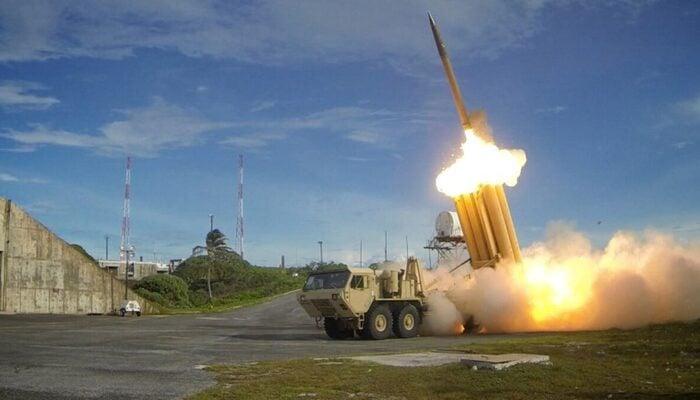
The US military used almost half of its arsenal of Patriot interceptor missiles during its seven-week campaign against Iran, according to an analysis by the Center for Strategic and International Studies (CSIS).
A report from a Washington-based media the hill highlighted the significant depletion of several key munitions, cited CSIS analysis and expressed concerns about Washington’s preparation for a possible conflict with China.
According to the CSIS study released Tuesday, U.S. forces fired nearly 50% of their Patriot missiles during the operation. More than half of the Terminal High Altitude Area Defense (THAAD) interceptors, along with more than 45% of the precision strike missiles (PrSM), were also used during the air and missile campaign in Iran.
The analysis further found that more than 20% of joint air-to-surface missiles (JASSM), more than 30% of SM-3 interceptors and at least 10% of SM-6 missiles were used as part of Operation Epic Fury.
CSIS warned that rebuilding stockpiles (including Tomahawk cruise missiles and JASSM) to pre-operational levels could take between one and four years. He noted that these weapons would be vital in any future conflict in the Western Pacific.
“Even before the Iran war, reserves were considered insufficient for a fight between peers and competitors. That deficit is now even more acute and building reserves to levels suitable for a war with China will take longer,” the report’s authors wrote.
While the United States likely still retains enough ammunition to continue operations against Iran, the remaining inventory would be insufficient in a confrontation with a major adversary like China, the report added.
Amid these concerns, the US Central Command (Centcom), which led the campaign in Iran, said its forces are actively rebuilding their capabilities during the ceasefire. In a social media message, CENTCOM said its “forces remain ready.”
Speaking alongside US Secretary of Defense Pete Hegseth, Centcom commander Admiral Brad Cooper said: “We are rearming. We are re-equipping and adjusting our tactics, techniques and procedures.”
“There is no military in the world that adjusts like we do, and that is exactly what we are doing right now during the ceasefire,” he added.
The findings come after President Donald Trump held talks with major defense contractors in March, after which he said production of “exquisite class” weapons would quadruple.
In response to the report, chief Pentagon spokesman Sean Parnell defended military capabilities, telling The Hill that the United States remains fully equipped.
“The US military is the most powerful in the world and has everything it needs to execute missions at a time and place of the president’s choosing,” he said.
“As secretary [Pete] Hegseth has noted on numerous occasions that it took less than 10% of American naval power to control traffic in and out of the Strait of Hormuz. Since President Trump took office, we have executed multiple successful operations across all combatant commands, while ensuring the U.S. military possesses a deep arsenal of capabilities to protect our people and our interests,” Parnell said in a statement. “Attempts to alarm Americans about the Department’s ammunition stockpile are both misinformed and disgraceful.”
Meanwhile, Pentagon Comptroller Jules ‘Jay’ Hurst said officials are planning to extend multi-year munitions contracts up to seven years, with the goal of strengthening supply chains and encouraging sustained investment. The measure is part of the administration’s proposed $1.5 trillion defense budget.
“Once Operation Epic Fury ends, naval assets sent to the Middle East will return to the Pacific. Ammunition inventories will begin to recover, but restoring depleted stockpiles and then reaching desired inventory levels will take many years,” wrote the report’s authors, Mark F. Cancian and Chris H. Park.