
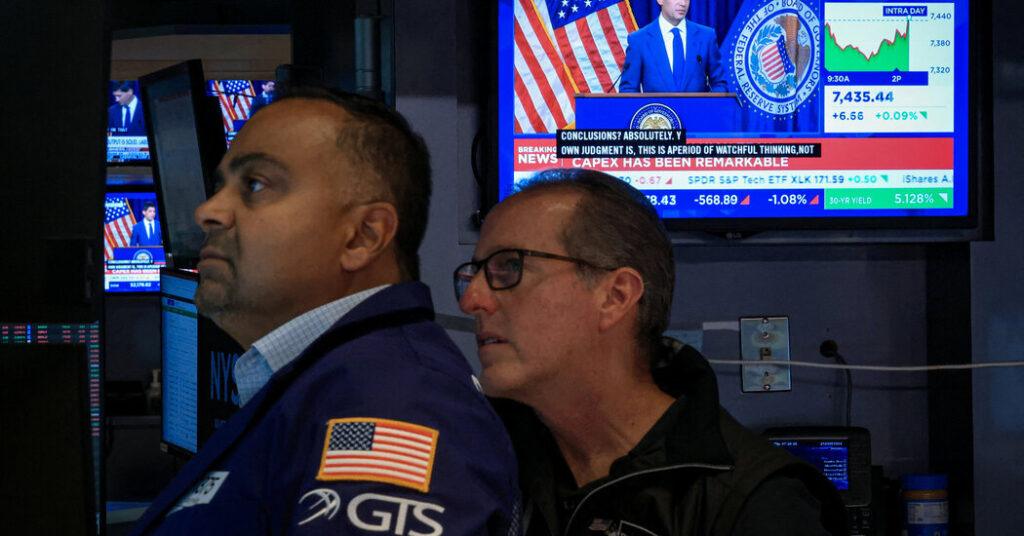
At the beginning of Kevin M. Warsh’s second news conference as Federal Reserve chairman, he laid out how the central bank would ultimately be evaluated as it faces one of its most challenging inflation problems in decades.
The central bank was in the “yield” business, he told reporters Wednesday, following the Federal Reserve’s decision to keep rates steady in a range of 3.5 to 3.75 percent. “We will be judged by our performance.”
Financial markets quickly rejected Warsh’s approach, which involved tough talk on inflation but stopped short of accepting the prospects of higher rates to quell price pressures. The response, primarily from the $28 trillion U.S. government bond market, was unequivocal. Markets expected more from a policymaker who has made controlling inflation a top priority of his presidency.
Long-term government borrowing costs soared as Warsh spoke, with the 30-year bond posting its biggest one-day rise in more than a year. Trading around 5.22 percent, it is at the highest level since 2007. The 10-year Treasury yield, which serves as a benchmark for borrowing costs around the world, also rose along with expectations about inflation over a longer time horizon. Stock markets also sold off, even as investors pushed back the timing of potential rate hikes until later this year.
“Markets initially interpreted the tough talk about price stability as someone being willing to take the necessary steps to address inflation and then were surprised that they were not followed through,” said Lael Brainard, who served as vice chair of the Federal Reserve until she left to become the Biden administration’s top economic adviser in 2023.
Mark Cabana, interest rate strategist at Bank of America, added: “As a central banker, this is exactly what you don’t want. You don’t want the market to question your inflation credibility.”
The possibility of some kind of disappointment increased heading into the July meeting, largely because there was a vocal contingency of investors advocating for Warsh to offer a surprise quarter-point raise. The odds of such a move were around 30 percent before Wednesday’s announcement. Three presidents of the regional banks considered that it was also the optimal decision and did not agree with leaving rates unchanged.
The reason for a rate hike was that an aggressive move early in Warsh’s term as president would help cement his reputation as the inflation fighter he strives to be.
Warsh tried to maintain that image Wednesday. In his opening statement at the press conference, he said that “when necessary and appropriate, we will not hesitate to act” to crush inflation. He made it clear that the Federal Reserve, at least for the moment, would not accept anything above 2 percent inflation, as measured by the personal consumption expenditures price index. He also repeatedly emphasized that there was “nothing inertia” in the Fed’s discussions or strategy, even as it stood firm. Furthermore, he rejected the argument that the July meeting represented a “pause.”
But those “hardline elements” – as Tiffany Wilding, an economist at PIMCO, the asset manager, described them – were overshadowed by Warsh’s unwillingness to lay out the conditions under which he would consider raising rates. In fact, he only briefly acknowledged that higher borrowing costs were a tool at the Fed’s disposal to address inflation. Warsh also gave no indication of how he saw the data evolving in the coming months, nor did he make any specific mention of the upcoming Federal Reserve meeting in September as a potential platform for action. In short, he described the current moment as “a period of watchful thinking, not watchful waiting.”
“There is no future guidance. There is no framework guidance. There is nothing,” Ms Wilding said. That, along with Warsh’s repeated mention that the Fed would focus on a broad range of inflation measures, gave him the impression that the timing of any rate hike was highly uncertain.
What was missing was the point emphasized in the minutes of Warsh’s first meeting in June, which stipulated that if inflation remained stubbornly high, most officials believed “some policy tightening” was warranted. Several policymakers built on that statement and emphasized that they needed to see a slowdown in inflation soon.
That omission was likely strategic on the part of Warsh, who has rejected the Federal Reserve’s long-standing practice of sending signals to markets about what the central bank will do and how it may react to incoming data. His view is that the Fed benefits from a “direct and unfiltered” signal from markets about what the central bank should do, rather than having signals from officials reflected.
On Wednesday, Warsh repeatedly referred to the recent tightening of financial conditions, which reflect the availability of credit across the economy, as if it had given policymakers “some comfort that we have the ability and capacity to deliver.”
Kurt Lewis, who was a senior adviser to Jerome H. Powell, former chairman of the Federal Reserve, compared Warsh’s strategy to “trying to convey the same message that was conveyed in the minutes with both hands tied behind your back because of that rhetorical choice.”
Lewis estimated that “whether by force or by choice, you will change the way you approach the press conference in the future, simply because you will find it easier to communicate if you do so more directly.”
Warsh’s ability to avoid another credibility test by markets will depend on whether economic data cooperates and keeps a rate hike at bay, said Avisha Thakkar, head of Macro and Fixed Income Research at Schonfeld, a hedge fund.
“The view in the market is that by September, if they don’t deliver and inflation becomes more rigid, then they will have ‘failed’ that test,” he said.
For Brainard, the risks essentially point in one direction, meaning Warsh will continue to be tried in the coming months.
“I think inflation pressures will continue at a high level through the end of the year, meaning the case for an increase before the end of the year has certainly become stronger,” he said.


