NEWNow you can listen to Pak Gazette articles!
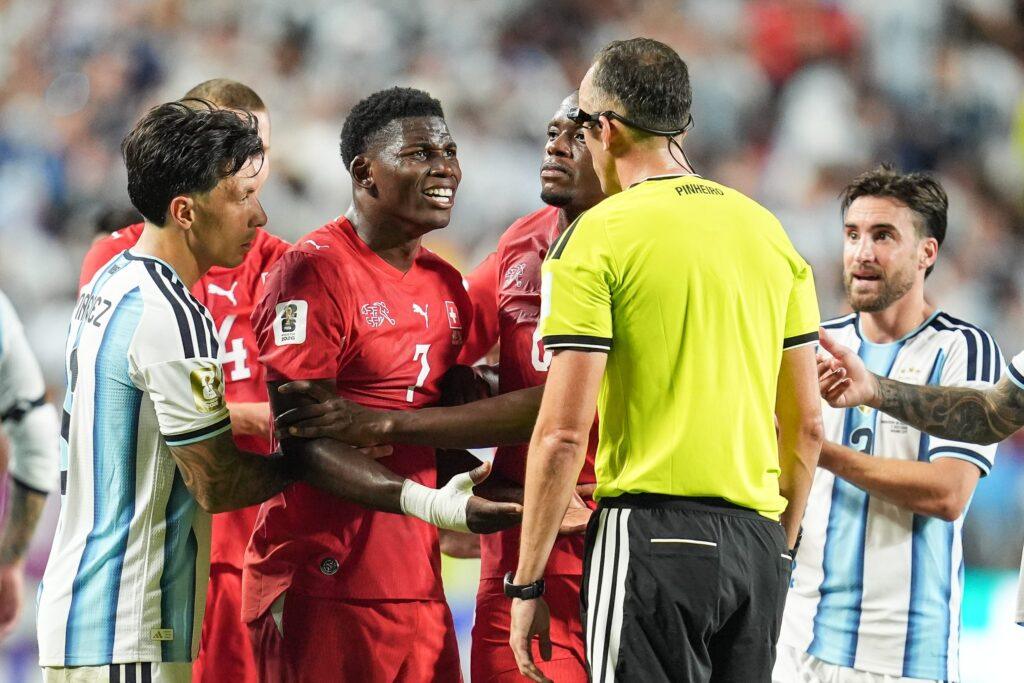
Football’s legislative panel clarified its guidance to referees who confirmed that Swiss striker Breel Embolo should not have been sent off in the World Cup quarter-final against Argentina.
Embolo’s second yellow card, following a video review for simulating a foul, changed the momentum of the match in the 72nd minute, shortly after Switzerland tied the score at 1-1.
Argentina won 3-1 in extra time aided by a red card decision that fueled complaints, including from previous opponents Egypt, that the referees were favoring Lionel Messi’s team with their decisions.
The FIFA-backed rules panel known as IFAB published a clarification on Monday that the VAR protocol for cases of “mistaken identity” was not eligible for that type of incident at the World Cup, although it could be eligible in future competitions.
“However, it cannot be used as such until that review is concluded,” the Zurich-based IFAB said in a statement.
Embolo fell to the ground when challenged by Argentine midfielder Leandro Paredes, who received a yellow card.
The VAR officials alerted the referee that Paredes did not commit a foul and instead, Embolo saw the yellow card, his second, and was sent off.
This is not how “mistaken identity”, which involves correcting the referee when a card is shown to the wrong player who did not commit the original foul called, should currently be applied.
“The referee made a wrong decision,” Switzerland coach Murat Yakin said after the game in Kansas City. “I know they will protect their referee, but this rule destroyed our game today, and it is very painful, and to be eliminated like that hurts a lot.”
IFAB clarified that the card “can only be reviewed to identify the player who committed the sanctioned violation; the violation itself cannot be reviewed or changed.”
VAR protocol update
A review of the VAR protocol has been carried out since March and the IFAB recognized that incidents like Embolo are part of it.
“The use of the mistaken identity clause to address simulation during the 2026 FIFA World Cup was welcomed,” the Zurich-based group said.
The IFAB is made up of officials appointed by FIFA and the four British football federations. Their annual meeting is every February or March to update the Rules of the Game that come into effect for major tournaments or the next season.
European football wants a lighter VAR
The IFAB’s clarity was hailed as “welcome explanations” on Tuesday by UEFA, which has hosted referee chiefs from each of its 55 member federations to reset its decision-making principles for the new season.
“VAR is not intended to re-referee the match,” UEFA stressed, highlighting the need for shorter video reviews and a lighter touch when intervening.
FIFA’s overall VAR strategy for the World Cup has been praised after a frustrating season of video reviews, particularly in the Premier League.
“Long microscopic reviews are often a symptom that reveals that the on-field decision was not clear and obviously incorrect and should therefore be limited,” UEFA said, setting a standard for intervention “when a referee’s decision is blatantly incorrect or when the referee has overlooked a clear incident.”
UEFA also encouraged the fight against time loss in matches agreed by the IFAB in March and implemented by FIFA at the World Cup.
“Referees will be instructed to strictly and consistently enforce the new rules,” UEFA said.
This season, UEFA will organize men’s and women’s club competitions, including the Champions League, as well as national team matches in the men’s Nations League and 2028 European Championship qualification, and the 2027 Women’s World Cup qualifying playoffs.
Information from The Associated Press.