
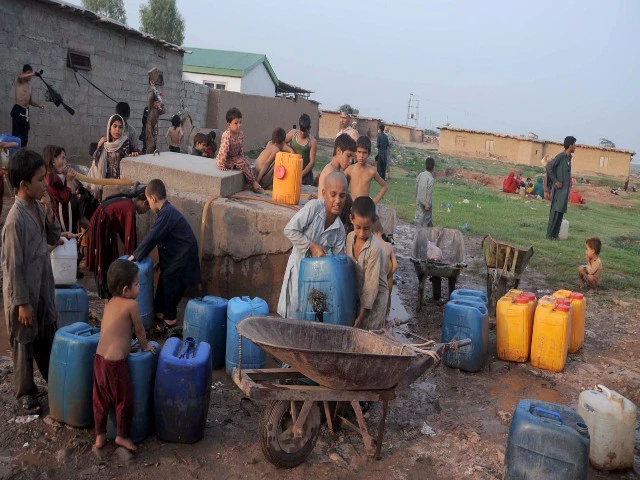
Water crisis in Rawalpindi. Photo: INP (archive)
RAWALPINDI:
Residents of Rawalpindi Cantonment Board (RCB) and Chaklala Cantonment Board (CCB) areas are facing an acute water crisis, with a widening shortfall in supply, declining groundwater yield and reduced inflows from the Khanpur Dam, leaving thousands of households struggling to meet their daily water needs.
The crisis has intensified despite a substantial increase in water rates by the cantonment authorities. The annual water supply bill for a five-marla residential property has risen from Rs 8,400 to Rs 14,400, while residents say the quantity of water supplied has continued to decline.
According to local officials and representatives, the water supply from the Khanpur dam has fallen from the allocated 19 million gallons per day (MGD) to just 11 MGD, while the discharge from tubewells has decreased significantly due to falling groundwater levels.
As a result, the combined daily water deficit in the two cantonment jurisdictions has reached 41.64 MGD, with many tube wells no longer producing enough water.
Residents of the cantonment areas complain that water is now only supplied every other day for 25 to 30 minutes.
In Rawalpindi Cantonment, the daily water demand is 50 MGD, while currently only 12.78 MGD is available, resulting in a daily deficit of 37.22 MGD.
Residents of densely populated neighborhoods, including Mughalabad and Azizabad, said the worsening shortages had made daily life increasingly difficult. They complained that despite receiving water for only half of the month, they continue to be billed for a full month’s supply.
Former RCB vice-president Malik Munir Ahmed said the cantonment was entitled to receive 19 MGD from Khanpur Dam but was currently receiving only 11 MGD. He stated that a considerable amount of stored water was being lost through seepage, aggravating the already critical situation.
Responding to the concerns, RCB chief engineer Ateequr Rehman Chaudhry said efforts were being made to improve the water supply system. He explained that the alternate day supply schedule had been introduced to allow for sufficient storage so that water could be distributed more evenly across localities.
The situation is equally alarming in the CCB, where the water supply system in all 10 districts is under severe strain. Against a daily demand of 10.12 MGD, there are only 5.92 MGD available, resulting in a daily deficit of 4.2 MGD.
Residents of Kamalabad, Jhawara, Tahli Mohri and neighboring localities said the prolonged shortage had forced them to buy expensive private water tankers. They claimed that repeated complaints lodged with the CCB had failed to produce any lasting solution.


