
A joint review committee will be formed for comprehensive legislation focused on acid regulation and victim protection.
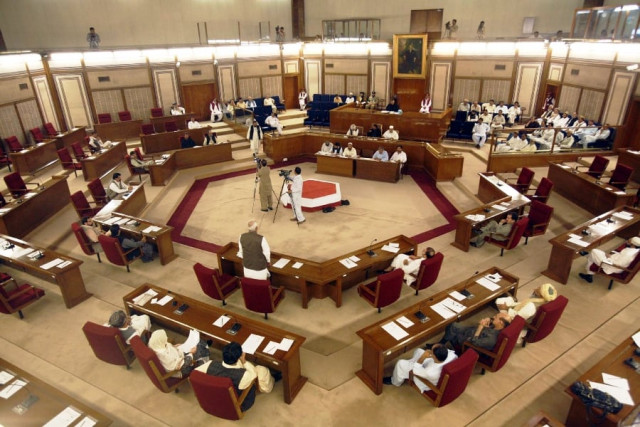
The Balochistan Assembly. PHOTO: EXPRESS
QUETA:
The Women’s Parliamentary Caucus (WPC) on Monday decided to fast-track legislation aimed at preventing acid attacks in Balochistan and ensuring justice and rehabilitation for the victims.
The development came after Dr Mahnoor was seriously injured when an attacker allegedly threw acid on her while she was on duty in the surgical ward of Quetta’s Sandeman Civil Hospital last week. The suspect fled the scene but was later killed in an exchange of gunfire with police.
A caucus meeting was held today at the Provincial Assembly Committee Room, chaired by Balochistan Assembly Deputy Speaker and WPC President Ghazala Gola. The session focused on measures to curb acid violence, strengthen relevant laws and support affected people.
Among those in attendance were WPC members Raheela Hamid Khan Durrani, Shahida Rauf, Farah Azeem Shah, Kulsoom Niaz, Salma Kakar and Shahnaz Umrani; Justice (retd) Kailash Nath Kohli; representatives of the Home and Law departments; UN Women officials; and Balochistan Assembly Special Secretary Abdul Rehman.
During the meeting, Justice (retd) Kailash Nath Kohli gave a detailed report on the existing legal framework in Pakistan regarding acid attacks and related crimes. He also updated participants on a proposed provincial law drafted in 2016.
Representatives of the Home Department presented official statistics that revealed that seven cases of acid throwing had been registered in Balochistan since 2021, and five cases resolved in 2022.
After extensive deliberations, participants unanimously agreed to form a joint review committee. The committee will examine the existing bill and incorporate stricter provisions related to the regulation of sale and use of acid, protection and rehabilitation of victims, compensation mechanisms and effective institutional responses.
The meeting members also recommended that in the next consultative session representatives from the Departments of Industry, Health, Public Prosecution, Women Development, Law, senior lawyers, the Department of Home Affairs and the police be invited to offer their inputs to make the proposed legislation stronger.
Read more: Quetta acid attack victim Dr Mahnoor stable, eyesight intact after treatment at AKUH
Participants further decided to review the composition of the board to be established under the proposed bill, ensuring representation of the Women’s Parliamentary Group and other relevant stakeholders.
It was also suggested that future consultations include members of the relevant Standing Committee on Home Affairs to achieve broader consensus and improve coordination.
Participants emphasized that a comprehensive and robust provincial law was essential to effectively prevent acid attacks, regulate the sale and use of acid and other dangerous chemicals, hold perpetrators accountable, and provide meaningful support and rehabilitation to survivors.
Concluding the session, President Ghazala reaffirmed the WPC’s commitment to continue its efforts towards enacting laws that protect vulnerable segments of society, promote justice and ensure strong safeguards against all forms of violence in Balochistan.
The injured doctor was a graduate student. She received initial medical treatment and was then flown to Karachi in a special air ambulance to ensure access to advanced medical treatment. According to doctors, approximately 35% of his face and body were burned.
The incident sparked a strong reaction from the Young Doctors Association (YDA), which called the attack a serious security breach.
Read more: Suspect killed in encounter after acid attack on doctor in Quetta
The association claimed that the suspect worked as a private elevator operator at the hospital and alleged that the attack was carried out with the intention of killing the doctor.
The YDA leaders demanded immediate transfer of the health secretary and the medical superintendent of the Civil Hospital, and called for a transparent judicial inquiry into the incident.
The association criticized the government for what it described as inadequate safety measures in public hospitals and announced a strike in response to the incident.
“This attack reflects a complete failure of security measures in hospitals,” the association said, urging authorities to determine responsibilities and ensure accountability.


