
Demands the immediate cessation of all settlement activities and rejects any attempt at annexation and forced displacement
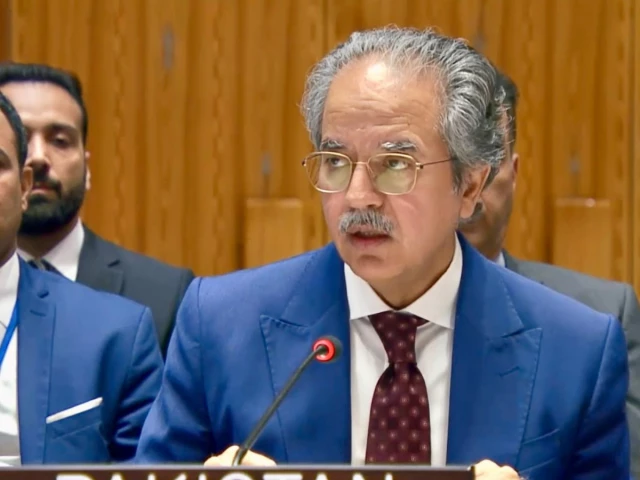
Pakistan’s Permanent Representative to the UN, Ambassador Asim Iftikhar Ahmad, addresses the United Nations Security Council. PHOTO: X
Pakistan on Tuesday urged the United Nations Security Council (UNSC) to ensure full implementation of the Gaza ceasefire and the peace framework endorsed by the Council, warning that delays risk “irreparably undermining the prospects for a just and lasting peace” and the establishment of an independent Palestinian state.
Addressing the UN Security Council’s open debate on the situation in the Middle East, including the Palestinian issue, Pakistan’s Permanent Representative to the UN, Ambassador Asim Iftikhar Ahmad, said the discussion offered “an important opportunity for a holistic assessment of the situation in the Middle East.”
Statement by Ambassador Asim Iftikhar Ahmad,
Permanent Representative of Pakistan to the UN,
In the open debate of the UN Security Council on the situation in the Middle East, including the Palestinian issue.
(July 28, 2026)
********Mr. President,
This debate is important… pic.twitter.com/boBO766hsP
– Permanent Mission of Pakistan to the UN (@PakistanUN_NY) July 28, 2026
He said the latest UN assessment showed that the Occupied Palestinian Territory remained “in a desperate situation”, adding that while the ceasefire and US President Donald Trump’s comprehensive plan to end the Gaza conflict had created “an important opportunity to alleviate humanitarian suffering and advance a credible path towards self-determination and the creation of a Palestinian state”, delays in implementing the initiative required “urgent attention”.
“It is imperative to maintain the commitments reflected in the peace plan and Security Council Resolution 2803 that endorsed it,” he stated. “Failure to act now risks irreparably undermining the prospects for a just and lasting peace.”
Regarding developments in the occupied West Bank, the Pakistani envoy said the continued expansion of Israeli settlements, the establishment of new outposts and increasing settler violence were “altering the demographic and geographical character of the occupied Palestinian territory.”
He also expressed concern about what he described as the planned “Crimson Thread” project, a proposed 500-kilometer network of walls and military roads through the Jordan Valley.
According to Ahmad, the project would isolate Palestinian communities, separate the Jordan Valley from the rest of the West Bank and “undermine the viability and territorial contiguity of a future Palestinian state.”
Read: Pakistan and Jordan discuss worsening situation in Gaza and diplomatic response
The ambassador said Pakistan had joined other members of the Group of Eight (G8) Arab and Islamic countries in condemning what they described as Israel’s escalation at the Al Aqsa mosque, particularly “the continued mass incursions of settlers.”
He said the group’s foreign ministers considered the actions “a flagrant violation of international law, relevant UN resolutions and the historical and legal status quo in the holy sites of occupied East Jerusalem.”
In Gaza, Ahmad described the humanitarian situation as “extremely fragile” and said that although the ceasefire and parts of the peace plan had brought some improvements, conditions remained dire.
He noted that 59% of Gaza’s population continued to face a critical level of food insecurity, while “since the ceasefire, more than 1,100 Palestinians have been killed.”
“This calls into question the full and faithful implementation of the Plan,” he stated.
The ambassador added that almost two million people remained confined to just 30% of Gaza territory, where they continued to endure “catastrophic living conditions.”
He also referred to reports of the construction of “a huge earth barrier” in Gaza, saying it would entrench Israeli occupation and control of almost 70% of the territory.
In that context, Ahmad said the Security Council must “act with unity” and outlined four immediate priorities.
First, he called on the Council to “support the full implementation of the Comprehensive Plan to End the Gaza Conflict and Security Council Resolution 2803.”
Secondly, it urged the Council to “demand an immediate cessation of all settlement activities” and reject “any attempt at annexation, forced displacement or alteration of the demographic and geographical character of the occupied Palestinian territory”, in line with relevant Security Council resolutions, including Resolution 2334.
Third, Pakistan called for “international protection for the Palestinian people,” echoing a call made by Palestinian President Mahmoud Abbas, while urging that “those responsible for crimes and violations committed against civilians” be held accountable.
Finally, Ahmad urged the immediate and unconditional release of withheld Palestinian revenues to allow the Palestinian Authority “to continue providing essential public services.”
Reiterating Pakistan’s long-standing position on the conflict, the ambassador said that “the only credible path to a just and lasting peace” remained the establishment of “an independent, sovereign, contiguous and viable State of Palestine, based on the pre-1967 borders, with Al-Quds Al-Sharif as its capital.”
Read more: The Israeli army detains at least 48 Palestinians in the West Bank and 8 are injured in an attack by the occupiers
Beyond the Palestinian issue, Ahmad said Pakistan remained “deeply concerned” about broader regional developments that were raising tensions across the Middle East.
He reaffirmed Pakistan’s support for “the sovereignty and territorial integrity of all brotherly countries in the region” and urged “all parties to exercise restraint, take immediate steps to reduce tensions and fulfill respective commitments under the Islamabad Memorandum of Understanding.”
“Pakistan remains committed to providing all support to achieve lasting peace and stability in the region through dialogue and diplomacy,” he added.
Addressing the situation in Lebanon, Ahmad said that the full implementation of UN Security Council Resolution 1701 remains essential to achieving lasting peace and stability. He also expressed gratitude for “the diplomatic efforts led by the United States to consolidate the cessation of hostilities and promote lasting peace in Lebanon.”
On Syria, the ambassador called for full respect for the country’s sovereignty and territorial integrity and reaffirmed Pakistan’s support for the Syrian government’s efforts “in this new stage.”
He said the 1974 Separation Agreement and UN Security Council Resolutions 338 and 497 “must be fully respected,” adding that “Israel must abandon its illegal occupation of all Arab territories.”
On Yemen, Ahmad reiterated Pakistan’s support for “a Yemeni-led and Yemeni-owned political process” aimed at achieving a comprehensive and lasting peace.
He condemned the attacks on Saudi Arabia, as well as attacks on commercial shipping, saying such incidents threatened “global trade and regional security.”
The envoy also expressed concern over what he described as attempts to drag Saudi Arabia into the broader Middle East conflict, reiterating Pakistan’s “unwavering support for the security, sovereignty, territorial integrity and prosperity of the brotherly Kingdom.”
Concluding his remarks, Ahmad said that lasting peace in the Middle East will remain unattainable “as long as the occupation persists and the legitimate aspirations of the Palestinian people for self-determination are not met.”
He reaffirmed that Pakistan would continue “in unwavering solidarity with the Palestinian people” and support “all genuine efforts aimed at achieving a just, lasting and comprehensive peace based on relevant UN Security Council resolutions and international legitimacy.”
Also on Tuesday, the UN deputy special coordinator for the Middle East peace process, Ramiz Alakbarov, expressed alarm at the “rapid deterioration” of the situation in the occupied West Bank and denounced the escalation of violence, particularly by Israeli settlers against Palestinians.
“Over the past week, escalating violence in the West Bank has led to civilian casualties, displacement, property damage and growing insecurity in affected communities,” he said.
“Attacks by Israeli settlers against Palestinian communities, homes, places of worship and civil infrastructure have persisted at alarming levels,” he said. Violence has erupted in the West Bank since Hamas’ attack on Israel on October 7, 2023, with almost daily attacks by Israeli settlers and periodic raids on Palestinian villages.


