
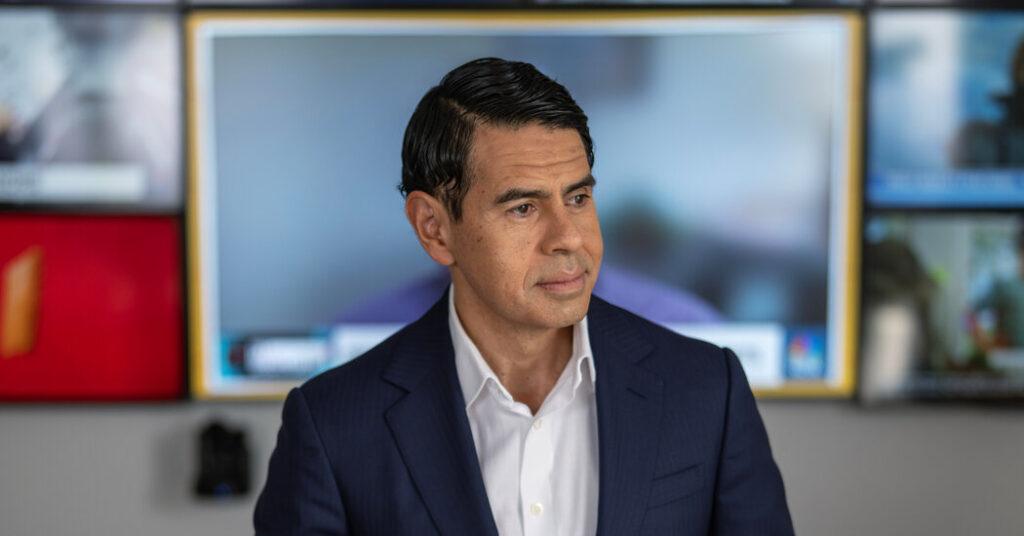
In his office, César Conde sits in front of a wall of television screens. They feature a wide range of programming from NBCUniversal News Group, which Conde has led as president since mid-2020.
He oversees top NBC programs such as “Meet the Press,” “Nightly News” and the “Today” show, a group of local broadcast stations in some of the largest markets in the United States and the Spanish-language channel Telemundo.
The division is the largest news media organization in the country. Every month, 136 million people consume the group’s content on multiple platforms. And it used to be even bigger: Earlier this year, a spinoff of long-running cable networks, including MSNBC and CNBC, became official.
During Conde’s tenure, as political polarization around the world intensified, Conde faced internal conflicts over programming decisions. NBC and other networks have also faced relentless attacks from the Trump administration, including threats to revoke broadcasters’ licenses.
And like all media organizations, Conde, 52, has sought to expand NBC’s digital presence as traditional broadcast audiences decline.
Conde, who is credited with turning around Telemundo’s fortunes before ascending to his current position, also serves on the boards of Walmart, PepsiCo and Ralph Lauren. Those brands are also trying to find an audience in a noisy and fractured market.
In an interview in his office, down the hall from the “Nightly News” studio, Conde said that while traditional media faced competition from all sides, people would eventually be overwhelmed by so much information. “When that pendulum swings, they will look for trusted brands and individuals,” he said.
Telemundo is betting big on the World Cup, which began Thursday, with Spanish-language coverage of all matches also broadcast on the NBC-owned streaming service Peacock. (Fox has the English broadcast rights.) Conde, who once dreamed of being a professional soccer player, sees the tournament as a rare global event with the ingredients to bring people together, at least for a few weeks.
This interview has been edited and condensed.
Recent polls show that Americans’ trust in the media has fallen to historic lows. How do you get people to trust a news organization like NBC?
If audiences don’t see the issues represented that impact them, they will tune out.
Premium video and local journalism through our local stations are alive and critical to the strength of our democracy. That’s why we invest so much in it and believe it’s one of the things that will hold its own against generative AI.
We launched an initiative called Common Ground. We started “Meet the Press” segments that brought together elected officials from different parties to discuss solutions to issues they agreed on. You see the ratings minute by minute: they increase with the Common Ground segment. We’re onto something.
It’s not just about politics. We bring together sports figures to talk about sports and others to discuss issues that unite Americans. Do you know what was one of the most important and highest rated events this year?
You tell me.
It was Artemis’s cover. Americans love space. Unite people.
We will always hold our leaders accountable and cover what makes people different. But it is equally important to show where we have common ground. We believe that generates trust.
Polls suggest that people want straight information and non-partisan news, but is that viable given the success that opinion shows and commentator coverage have had?
The answer is yes. We take a very direct approach of providing fact-based, opinion-free journalism to serve our community on the issues that matter most to them.
We are playing for the long term. We want to make sure that when audiences feel too overwhelmed by the endless content ecosystem, they know that there is a place they can turn that has the most trusted brands, that has the most trusted journalism, that will help them clearly understand what is at stake.
You mentioned generative AI, which is diverting attention from reported news. How do you respond to all the AI crap out there?
We will continue to see, at least in the short term, more and more content coming from AI. However, eventually, we believe there will be a shift where audiences will return and be hungry for news and fact-based information.
What gives you that hope?
People, at their core, still want accurate, quality information.
There has been a lot of pressure from the Trump administration on the media, through lawsuits, access restrictions and other actions. How concerned are you about press freedom?
We are fundamental believers in the First Amendment. We believe that a strong, free and independent press is fundamental to the health and strength of our democracy. And we firmly believe that providing more access to our audiences and our viewers is better than less. Therefore, we will continue to ensure that we provide as much access as possible to the public day in and day out.
Does it feel harder to do that now?
In the journalistic profession we have always had a series of pressures. But our mission at NBC News has always been to hold our leaders accountable.
Let’s talk about the turmoil in C.B.S.one of its main competitors. Both you and Bari Weiss, who was recently named editor of CBS News, had unconventional backgrounds.. You were from the corporate sector and she had not worked in broadcasting. What have you learned over the years that you think she could apply?
My approach has always been one of servant leadership. My role is to bring together teams that are smarter than me in different capacities and make sure I support them. It’s a very methodical approach to ensure we have the best and let them shine.
How do you earn a newsroom?
I have always been aware that the most important thing is to invest in original journalism. So it’s about ensuring our journalists know that A, we have their back and B, we will always invest in original, premium journalism that serves our communities. The rest is simply about attracting and retaining the best journalists.
I want to ask you about Telemundo, since before you managed it directly. One of the most important demographic changes in the United States is the growing Latino population. What does that mean for the network?
We believe Telemundo is one of the largest strategic growth opportunities for NBCUniversal.
The Hispanic community is large. It is not monolithic. It exists in every corner of the United States. I was born here and grew up speaking two languages. One of the most interesting and fastest-growing parts of the Hispanic community is what we have called the 200 percenters: people who are 100 percent American and 100 percent Latino. There are topics that you find on Telemundo that you may not find anywhere else.
Like what?
Telemundo’s local newscast in Los Angeles will have anchors representing that local community, in theory primarily Mexican-American. We will cover topics that are unique to that community.
The Miami coverage on Telemundo’s local station has hosts who are representative of that community (Cuban or Venezuelan and the like) and the coverage of what’s happening in Cuba and Venezuela is more predominant than it would be on a local station in, say, Dallas, Chicago or Los Angeles.
The World Cup will be a great moment for your Spanish programming.
Our Telemundo team has this great philosophy that some things are better in Spanish and soccer is just one of them.
For us, having one of the largest global sporting events in such a fragmented world is essential. It’s a lot different than it was 30 years ago, when the United States last hosted the World Cup. Today’s football has gone from being a niche to being something mainstream.
It is also seen by a younger demographic that is very attractive to companies. We have an audience that we have called the 3M: millennial, multicultural and mobile. It’s at the heart of the type of audience we want to continue to attract, and an audience that Fortune 500 companies want too.
Tell me about your education. Were you born and raised in Miami?
Like millions before them, my parents were immigrants to the U.S. My mom from Cuba, my dad from Peru. My two younger brothers and I were born and raised in Miami with very traditional immigrant values and work ethic: dream big, work hard, and be humble.
Have you always wanted to work in the media?
Like every immigrant child, you were supposed to be a doctor or a lawyer. I grew up playing soccer and then tennis. Like every child, you think you are going to be a professional athlete.
It took me a little time in life to discover my path. I worked on Wall Street in investment banking, at a startup, and in public service, in the White House Fellows Program under Colin Powell when he was Secretary of State.
We became good friends. He was the one who advised me to take my interest in working in the immigrant or Hispanic community and merge it with the media industry.
You have been a great supporter of diversity initiatives. Last year, the Federal Communications Commission opened an investigation into NBCUniversal’s parent company, Comcast, over its diversity practices. Has that changed the way you approach these programs?
Our values have always been the same and will remain the same. We will hire the best because it is right for the business. But to be the best – in the context of serving every corner of every community in America – we have to select from every corner of every community in America.
It’s time for the lightning round. What is the first app you open in the morning?
The NBC News App.
Good answer. What would you say is the most used app on your phone?
Probably Uber Eats.
What drives you during the day? Coffee, tea, adrenaline?
Having grown up in Miami, it is a strong coffee.
What is your favorite television show?
Aside from the news, I’m old school. I’m a big “Seinfeld” fan.
What’s a show you love that people would be surprised if you watched? “La Casa de los Famosos”, which is Telemundo’s unscripted reality show.
What’s the last question you asked AI?
What is the best result that the United States team has in the World Cup?
Do you think about business in English or Spanish?
I do some things in English and others in Spanish; Business strategies are mainly done in English.
What happens when you dream? English or Spanish?
Both.


