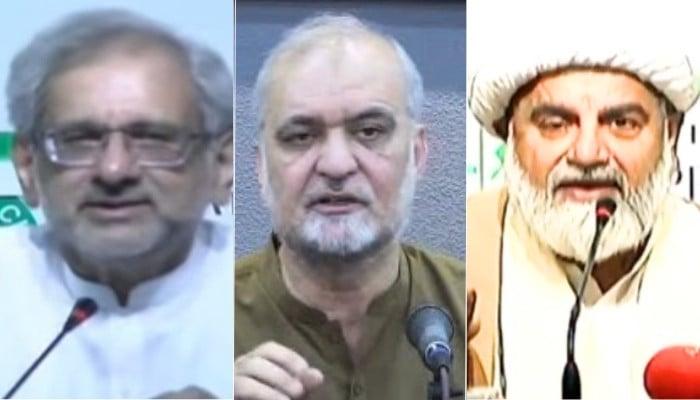
- Abbas says the rulers are unwilling to face the facts.
- Khokhar links rising poverty to policy failure.
- Abbasi says the debt crisis is becoming serious.
ISLAMABAD: Opposition leaders on Sunday rejected the federal budget, accusing the government of ignoring economic realities, overburdening citizens with taxes and failing to address growing poverty.
“They [rulers] They are fooling themselves,” said Senate Opposition Leader Allama Raja Nasir Abbas while speaking at a budget seminar in Islamabad, criticizing the government’s claim that a person earning Rs 280 a day is not below the poverty line.
Abbas said the rulers “were not prepared to see the events with their own eyes” and alleged that the government had failed to provide services to the people.
“The people of Pakistan are being crushed in the mill of poverty,” he said, adding that food prices were “touching the sky.”
Comparing the country’s finances with the family budget, the opposition leader said that when a family’s expenses exceed its income, it becomes burdened with debt and then begins to sell its assets.
“Pakistan’s revenue is less than its expenditure,” he said, adding that no serious effort had been made to reduce expenditure and increase revenue.
Abbas also warned that if the next elections were held under the same system, the results would be “the worst.”
“The budget cannot be successful without solving public problems”
Tehreek-e-Tahafuz-e-Ayeen-e-Pakistan leader Mustafa Nawaz Khokhar said rising poverty was proof of failure of economic policies.
“The true measure of economic growth is the improvement in people’s lives,” he said, adding that life had become difficult for low-income groups.
Khokhar said that a tax system could not be effective without state services, and emphasized that citizens should be given facilities if taxes are collected from them.
“Economic success is meaningless if poverty is not reduced,” he said, adding that the budget could not succeed without solving public problems.
He said the government had failed to reduce its own expenditure, while heavy taxes continued to be imposed despite a lack of services.
“The budget is a sign of economic crisis”
Senior PTI leader Salman Akram Raja described the budget as an “economic emergency” for Pakistan and said the country’s economy was trapped in a serious crisis and debt burden.
He said claims about economic development were contrary to reality, while rising loans posed a major threat to the country’s future.
“The federal government is stuck paying interest,” he said, adding that running the system through loans was not a sustainable solution.
Raja said poverty was increasing rather than decreasing, while Pakistan was far behind in spending on health and education.
“Investment in human development is necessary to compete globally,” he said, adding that fundamental changes are needed to address the economic crisis.
“There is no serious effort to cut expenses”
Former Prime Minister and Pakistan Awam Party leader Shahid Khaqan Abbasi said the last four years had been the worst for Pakistan’s economy.
He said government spending had become greater than development spending, while pension spending had exceeded the cost of running the government.
“Interest and debt payments have started to exceed revenues,” Abbasi said, adding that the country’s debt is increasing every year and the crisis is becoming more serious.
He said the additional taxes had placed an additional financial burden on the people, while the government was taking new loans to cover its expenses.
Abbasi said requests for budgetary help seemed far from reality, adding that ordinary Pakistanis were bearing the burden of indirect taxes.
He also called for basic reforms in the system, saying investment would not happen without rule of law, political stability and policy continuity.
‘The budget only changes the numbers’
Jamaat-e-Islami Emir Hafiz Naeemur Rehman said Pakistan had a “cruel tax system” and claimed that the common man paid 60% taxes.
“People don’t get any relief in the budget; only the numbers are changed,” he told a news conference in Islamabad.
Hafiz Naeem demanded the abolition of the oil tax and called for an end to capacity charges on independent power producers.
He also said that funds for MNAs in the Public Sector Development Program should be abolished and that official vehicles should not exceed 1,300 cc.
“The budget has become simply the name of numbers that go up and down,” he said, adding that electricity, oil and gas prices directly affect the population.
He said the government itself admitted pressure from the IMF, while large sums had been kept in the budget to hide incompetence.