
Ask most people how a cryptocurrency is priced and they will describe spot trading: buyers and sellers meet on an exchange, and the last trade prints the price. But that hasn’t actually been the case for years when it comes to bitcoin, ether, and the broader crypto markets.
Perpetual futures, also called perpetual swaps or “delinquents” for short, are leverage-friendly contracts that never expire, and now account for approximately 93% of all crypto futures volume, with daily delinquent volume routinely greater than the spot market beneath them.
A traditional futures contract has a settlement date, which is when it expires and its price is forced to equal the spot price of the object it follows, also called the underlying. But a lifer does not have that date and can be held indefinitely (by paying a cost known as a “funding fee,” which varies daily).
A body of work on market microstructures has asked which place “discovers” the price of bitcoin first, that is, where new information enters the market before it appears anywhere else. The response has repeatedly come back pointing to derivatives.
A study published in the Journal of Financial Markets by Carol Alexander and her co-authors found that perpetual swaps in unregulated venues were the strongest instruments for bitcoin price discovery, with regulated futures and US spot exchanges reacting to those moves, rather than leading them.
Other work has identified the Binance perpetual market as the primary source of price formation across the fragmented crypto landscape.
However, the evidence is inconclusive and some studies find that there are still specific drifts at certain frequencies or during stress. But the direction of the literature in recent years has been toward the derivatives market as the place where price is set.
“Historically, we have seen criminals leading primarily during bear market price rallies,” Julio Moreno, head of research at CryptoQuant, told CoinDesk. “For example, growth in demand from Bitcoin criminals (blue bars on the chart) led the January 2026 and April-May 2026 price surges.”
“In these periods, spot demand was contracting, while felon demand was expanding, so the perpetual futures market was leading prices even though demand was contracting in the spot market,” he said.

Which brings us back to the financing rate. Because a perpetual contract never settles, nothing forces its price back to spot like an expiration date does for a traditional future. Instead, every few hours, the busiest side of the trade pays the other.
When the offender is trading above the spot price, traders who are long (or betting on higher prices) pay those who are short (betting on lower prices), which pushes the contract towards the underlying price.
The funding rate is both the tether that keeps the contract anchored and a live reading of sentiment, which is why some traders follow it as closely as the price.
“We actually surveyed over 100 of our traders,” Hong Yea, co-founder of on-chain trading platform Grvt, told CoinDesk. “Traders who really rely on us to hold real conviction positions want predictability there, not another data point to interpret.”
“If you hold a directional position for weeks, funding doesn’t tell you anything new about the market, you’re just eating up your PnL while you hope you’re right. That’s the honest way our users describe it to us, not, ‘what’s the market telling me,'” Yea added.
The SpaceX use case
None of this requires a spot market to exist. And for about three weeks in May and June, one of the most watched markets in the world was for a company that had never sold a public stock and was trading on crypto rails.
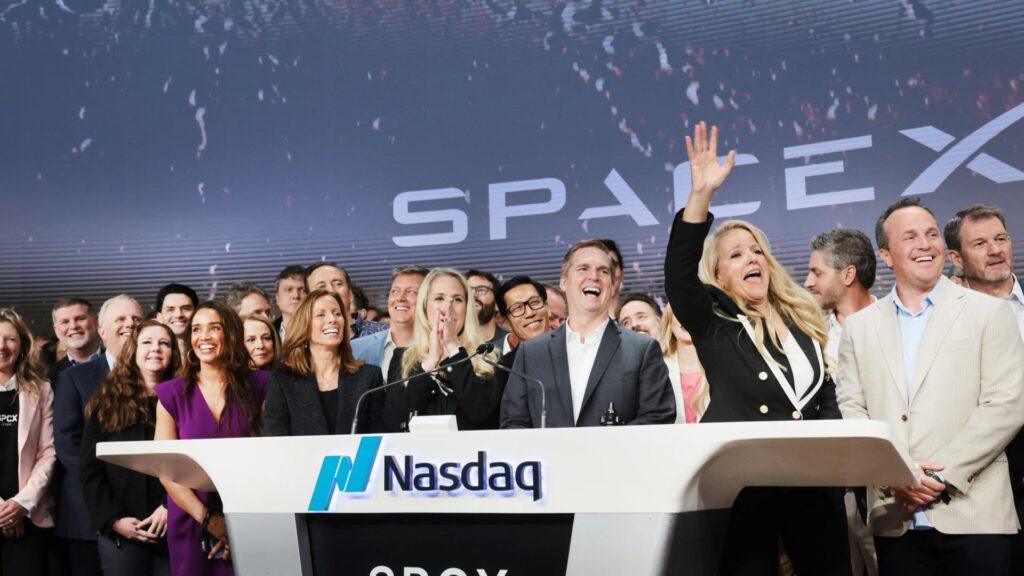
Elon Musk-owned SpaceX priced its record $75 billion initial public offering at $135 per share and began trading on the Nasdaq on June 12. Long before that, traders at Binance, Coinbase, Hyperliquid and others were already buying and selling exposure to the company through pre-IPO perpetual futures, or contracts structured to track an implied valuation rather than a share price.
First to act was Hyperliquid, the on-chain derivatives exchange, where a synthetic SpaceX perpetual went live on May 18. Binance opened its own SpaceX marketplace on May 21, Coinbase followed on June 4, and BitMEX, Bitget, and OKX later added their own contracts.
What is surprising is how right they were at the time when their accuracy could be proven. The night before SpaceX’s listing, Hyperliquid and Binance perpetuals were trading the equivalent of about $170 per share, well above the $135 that underwriters had pegged.
The next day, SPCX opened, hit an intraday high above $176, and closed its first session at $161, an increase of 19%. Shares printed almost exactly where the criminals had left off, and a market dominated by retail traders seeking leverage had read the first day’s demand more accurately than the banks that spent months constructing the offer price.

Money was also in that gap. The perpetual market priced SpaceX well above the IPO price of $135, so traders could buy the contract before it went public and bet that the two would meet. Each of these contracts was created to automatically change to the actual SpaceX stock price at the time the stock began trading, so that any gap between the perpetrator and the final opening price would close on its own. With the IPO already four times oversubscribed, direction was rarely in doubt, and the pre-listing window was the only place to get the deal done.
Then reality caught up with the market that had predicted it. SPCX has fallen more than 40% since its June peak, falling from the IPO price of $135 to approximately $115 at press time.
The reason is one that the perpetrator could never have priced in: supply. Only a small portion of SpaceX shares were sold in the IPO, and as of August 6, approximately 900 million locked-in privileged shares will be eligible to be sold.
What SpaceX showed in the extreme is what research says is already true in ordinary cryptocurrency trading: the derivatives market is increasingly the place where price is discovered. Spot follows.
Criminals are excellent at pricing demand and are blind to supply, which is worth remembering whenever a bitcoin rally or rise in funding rate begins before it peaks.


