
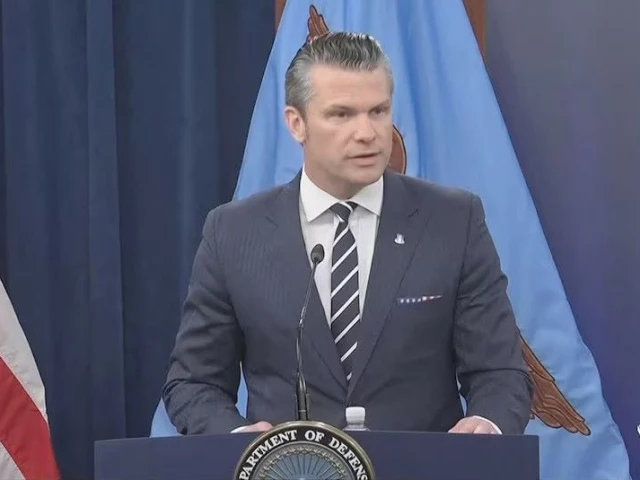
US Secretary of Defense Pete Hegseth holds a briefing at the Pentagon after the US attacked Iranian nuclear facilities during the Israel-Iran conflict in Arlington, Virginia, US, on June 22, 2025. In this still image taken from a distributed video. PHOTO: REUTERS
US Defense Secretary Pete Hegseth praised Prime Minister Shehbaz Sharif and Chief of the Defense Forces and Chief of Army Staff Field Marshal Asim Munir for their role in the US-Iran peace negotiations, saying Washington and Islamabad are developing a “true friendship.”
“I mentioned India here, but I could very easily have mentioned Pakistan and the role that the field marshal and the prime minister are playing in the peace negotiations,” he said while responding to a question at the Shangri-La Dialogue in Singapore.
“I think that an unexpected event and a true friendship [are] developing there, which I think is important.”
Relations between Pakistan and the United States hit rock bottom in 2011 after the U.S. raid on Abbottabad that killed al Qaeda chief Osama bin Laden. They improved somewhat in 2020, when the United States recognized Pakistan’s role in facilitating the Doha Agreement with the Afghan Taliban.
However, with the arrival of President Joe Biden in 2021, diplomatic ties froze again. They were relegated to the background for much of their tenure as the Biden administration leaned on India to counter China’s growing influence in the region.
Relations between the two countries have reached a new high during President Trump’s second term. In March 2025, weeks after Trump’s second inauguration, Pakistan arrested and extradited to the United States an Islamic State-Khorasan (IS-K) operative, Mohammad Sharifullah, accused of helping plan the 2021 suicide bombing outside Kabul airport that killed 13 American soldiers.
That led Trump to praise Pakistan at the start of his second term. “I especially want to thank the government of Pakistan for helping to arrest this monster,” Trump said in his first speech to Congress during his second term.
Diplomatic engagement between the United States and Pakistan reached new heights after Trump helped broker a ceasefire between Pakistan and India during their brief war.
Since then, the leaders of both countries have exchanged cordial gestures and praised each other’s leadership on international platforms. Prime Minister Shehbaz even nominated President Trump for the Nobel Peace Prize in recognition of his mediation efforts.
Trump, in turn, has frequently praised Prime Minister Shehbaz and Pakistan’s military leadership, describing CDF Munir in particular as his “favorite quarterback.”
Building on this positive momentum, Islamabad is now seeking to translate goodwill into tangible economic benefits by pursuing a more favorable trade deal with Washington, including tariff concessions and greater market access for Pakistani exports.
More recently, after a war broke out between the United States and Iran in February this year, Pakistan emerged on the international stage as a peace mediator. Islamabad negotiated a two-week ceasefire between the United States and Iran on April 8, followed by critical talks in Islamabad attended by high-level delegations from both countries on April 11 and 12. However, neither party could reach an agreement to end the conflict.
The two sides have since exchanged proposals and counterproposals in an effort to find common ground and resume a second round of direct talks aimed at ending the conflict.


