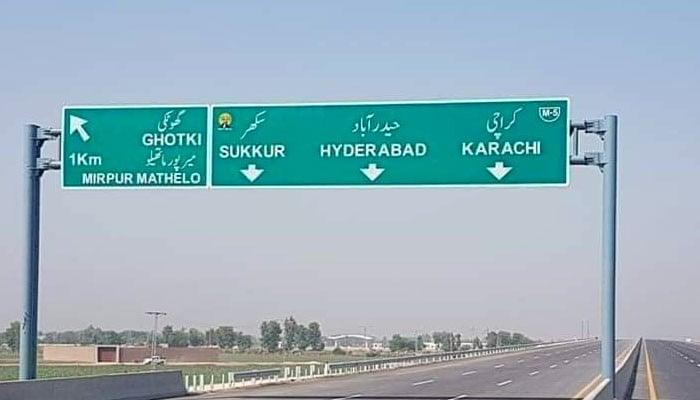
The National Highways Authority (NHA) and the Asian Development Bank (ADB) have signed a landmark agreement for the construction of two sections of the M6 motorway.
In a post on
In February, Communications Minister Abdul Aleem Khan announced that construction of the M6 motorway would officially begin in May under a public-private partnership model.
The minister termed the project as a vital gateway to Pakistan’s future development and a decisive step towards economic prosperity.
“A project that remained stagnant for more than 30 years, achieving this progress in just two years of dedicated effort,” he said.
Aleem Khan emphasized that the M6 motorway represents the “missing economic link” of the country’s North-South corridor, making its completion an absolute necessity for sustainable national growth.
He noted that this expressway was among Pakistan’s most critical infrastructure assets, designed to serve as a backbone for the country’s future trade and logistics.
Completion of this missing link would revolutionize Pakistan’s transportation network by allowing traffic from Karachi port to travel seamlessly to Peshawar and Gilgit through a continuous highway system, he added.
Giving details of the project, the federal minister said that the 306-kilometre-long, six-lane project will be equipped with modern toll and security systems, with 15 interchanges and 10 state-of-the-art service areas to facilitate both commuters and commercial transporters.
He further said that the project structure included two key sections from Hyderabad to Nawabshah, which would be developed under a public-private partnership (PPP) model to ensure transparency and attract private sector investments.
“The Islamic Development Bank (IDB) and the OPEC Fund have already approved financing for three other sections,” he said, adding that the entire M6 project is scheduled to be completed in the next two years.
He concluded by stating that connecting Karachi ports with northern regions is a national priority that would unlock new investment opportunities and strengthen Pakistan’s regional trade connectivity.
— with additional APP information